Not in My Belts! I Wet My Pants Again
Where peeing in your pants was once thought to only affect women who've had babies or entered the years of menopause, peeing in your pants has become equally common equally a barbell athlete losing a deadlift due to grip failure. Over the concluding 8 years, the growth of powerlifting has been tremendous and participation at U.s. Powerlifting (USAPL) Raw Nationals has increased 6.8x from 183 in 2012 to one,260 lifters in 2019. This exponential rise in popularity comes with a near fifteen% rise in female participation as a whole, with women representing 49% of all Open class participants in 2019.

With the increasing popularity and number of participants in barbell grooming and powerlifting equally a whole over the concluding decade (particularly females) an age-one-time upshot has get an epidemic in a new population [1]. The rising in participation and popularity has not just led to college qualifying totals and more than and more than females squatting and deadlifting well over 400 pounds, only it has besides led to women pushing harder and harder in the sport with every yr information technology grows.
MY STORY
My interest in understanding and helping women who powerlift combat urinary incontinence stems from a personal feel in my early on years of powerlifting. I had simply competed at Raw Unity seven (one of the biggest competitions in powerlifting at the time) and was eager to do the next, biggest, competition in the USA. Having never competed in United states of america Powerlifting (USAPL) earlier but wanting to compete at the Arnold Classic in Columbus, Ohio, I had a couple of hoops to leap through first. I needed to participate in a local USAPL contest in society to authorize for Raw Nationals, which would hopefully authorize me for the USAPL Raw Challenge at the Arnold Sports Festival.
So, 4 weeks after peaking for my biggest competition however, I participated in a run across in the heart of a preparation cycle and un-peaked. Nosotros knew my worst mean solar day would more than qualify me to attend USAPL Raw Nationals so nosotros didn't think it was necessary to re-peak or hit max attempts. The plan was to become in and treat the meet like a training session.
That's not what happened.
Take a upwards-and-coming competitive meathead powerlifter and put her in a local meet still coming off the mental and emotional high of her last one…I broke all my rules. I didn't follow my normal meet-day eating, hydration, and caffeination plan, and I attempted PRs on all my lifts. Lucky for me, I did pretty well and hitting pocket-sized 2.5kg personal records on my squat and bench press. Only come time for deadlift I was overly hydrated, full, and super caffeinated.
Every bit I got to the top of my final deadlift I started to rock back and along; I was hitching because the load was too aggressive and simply also heavy for that day. And then something weird happened. I felt an extremely warm sensation fill my pants as I struggled to lock out the deadlift. Normally, I'd encourage my lifters to keep to lock out the bar despite hitching considering we need to leave information technology upwardly to the judges, just I was so worried that I had completely soaked my pants that I gave up. I didn't have it anyway; information technology was but too heavy.
After that moment I began to develop anxiety that it was going to happen again even though it had never happened before. And considering of my fear, I started to utilize the bathroom multiple times during two hour training sessions, "just in case." While information technology actually never did happen again, the amount of time I was spending in the bathroom was becoming a burden and wasn't normal. I needed to figure out a way to break this bad habit and and then I began to retrain my bladder only similar I train my lifts.
To this day, 6 years later, I accept yet to wet my pants again. Only we meet women left and right soaking their pants and the platform, tampons and pads falling out of gym numberless and women changing their pants or singlets in the heart of training and meets. I've had the opportunity to speak with and work with many women to help them overcome this very common powerlifting-specific problem.
THE DATA, INFO & SCIENCE
In a 2017 survey study conducted on high-level female person powerlifters between the ages of eighteen and 35, 74.5% were found to experience symptoms of incontinence while training and 84% of those with symptoms spoke to other females, 45% spoke to their coaches, 23.5% spoke to a medical profession and 10.5% spoke to no 1 [ii].
We often hear women write this off as "it's normal," "it happens to everyone," or "YOLO because information technology's game day," but beingness prevalent doesn't mean information technology's normal or you need to suffer from the emotional and physical touch on it can have on yous long term [3]. Wetting your pants when you elevator tin lead to:
-
Embarrassment
-
Missed lifts
-
Poor performance
-
Frustration
-
Loss of motivation to train
-
Cessation of participation in powerlifting
Adaptive strategies like preemptive voiding, reduced fluid intake, pads, tampons, pessaries, and diva cups are not addressing the trouble, they're just masking it. If left unchecked and written off as "this is what I get for lifting heavy," urinary incontinence in the young, no-risk-gene female powerlifter has the potential to plough into a true pelvic flooring injury like whatsoever other nagging issue in powerlifting has the potential to lead to an astute or chronic injury.
With that said, it's essential for coaches and barbell trainees to take an agreement of the unique causes and potential treatments available in the female powerlifting population as the impact Urinary Incontinence has on the quality of life and desire to participate fully in barbell training on the female athlete is profound.
Urinary Incontinence (UI) is the involuntary leakage of urine, in whatever amount, due to some type of stress to the torso, urgency, a mix of both, and other factors not relevant to this commodity. Urinary Incontinence can affect both females and males just is far less common in men [4]. On a urodynamic level, this leakage of urine is specifically associated with a failure of the bladder and pelvic floor muscles to work in synchrony. With typical cases of UI in the general population, the asynchrony is often a main dysfunction in the continence arrangement, but this is NOT what's occurring in young, healthy females who accept no pregnancy history or symptoms outside of preparation.
In the traditional sense, the virtually common risk factors for UI in the general , not-competitive lifting population are as follows [4]:
-
Gender: Females are much more likely to experience SUI than males
-
Age: Due to hormonal changes associated with historic period and menopause, as well as changes in collagen elasticity and musculus strength, the older you go, the more susceptible you are to UI.
-
Obesity: College Body Mass Index (BMI), abdominal adiposity, and waist-hip ratio all correlate largely to the presence of UI in the general population.This is due to the increase intravisceral pressure and its effect on the bladder. Additionally, studies accept shown the overweight and obese women are likely to accept a mutation in the B3-adrenergic receptor that affects detrusor (bladder) muscle command.
-
Smoking: Studies have shown straight physiological effects on muscle strength and elasticity as well as indirect effects on UI due to chronic lung diseases that cause chronic coughing.
-
Pregnancy & Childbirth: At that place is an increased likelihood of symptoms in women who have had 1 or more pregnancies (with or without deliveries) due to the hormonal and physical changes in the abdominal and pelvic neuromuscular system.
With the most mutual risk factors outside of gender existence Age, Obesity, Smoking and Pregnancy/Childbirth, then why is there a 74.5% prevalence of Urinary Incontinence in immature (18-35 years erstwhile), not-child bearing female powerlifters during preparation but? And is it the same diagnosis as traditional UI and thus appropriate for the same treatments?
The purpose of this 4-role serial is to discuss mutual reasons why the young, nulliparous female powerlifter with low-to-no risk factors is experiencing episodes of incontinence in training, on the platform, and not exterior of grooming, equally well as to identify conservative, not-invasive, practical ways to manage symptoms. We'll also discuss how and when to seek boosted help and what kind of practitioner to accomplish out to for help.
IS THIS AFFECTING You?
When evaluating a female barbell trainee to accost the road-cause of the outcome we demand to investigate a few things:
Are symptoms experienced outside of training or are there other pelvic symptoms occurring as well?
This is the virtually important question that distinguishes powerlifting urinary incontinence (PUI) from traditional UI.
If the answer is yes and in that location are symptoms outside of training, pain with intercourse, or other types of pelvic pain, so information technology's best to become a pelvic health specialist to evaluate what additionally could be contributing to your symptoms.
If the answer is "no," then as a jitney or trainee, you are closer to solving this problem than any concrete therapist, urologist, or gynecologist who wants to manually evaluate your individual parts, prescribe kegels, order you a biofeedback intravaginal device for while yous're squatting, and tell you not to lift considering you're damaging your pelvic floor.
Identify when the symptoms are occurring:
-
What lift and when in the range of motion of that lift?
-
What loads and intensities do the symptoms come on at?
-
What rep schemes are symptoms most prevalent with?
-
Does lifting with or without a belt brand a deviation?
-
Is the Valsalva Maneuver being performed correctly?
-
Are symptoms worse before the onset of menstruation or with constipation and gas?
Investigate psychological factors that may influence symptoms:
-
Take you lot witnessed others experiencing it?
-
Has it happened to you a few times in the past or is this a regular occurence?
-
How often do you use the bath during training?
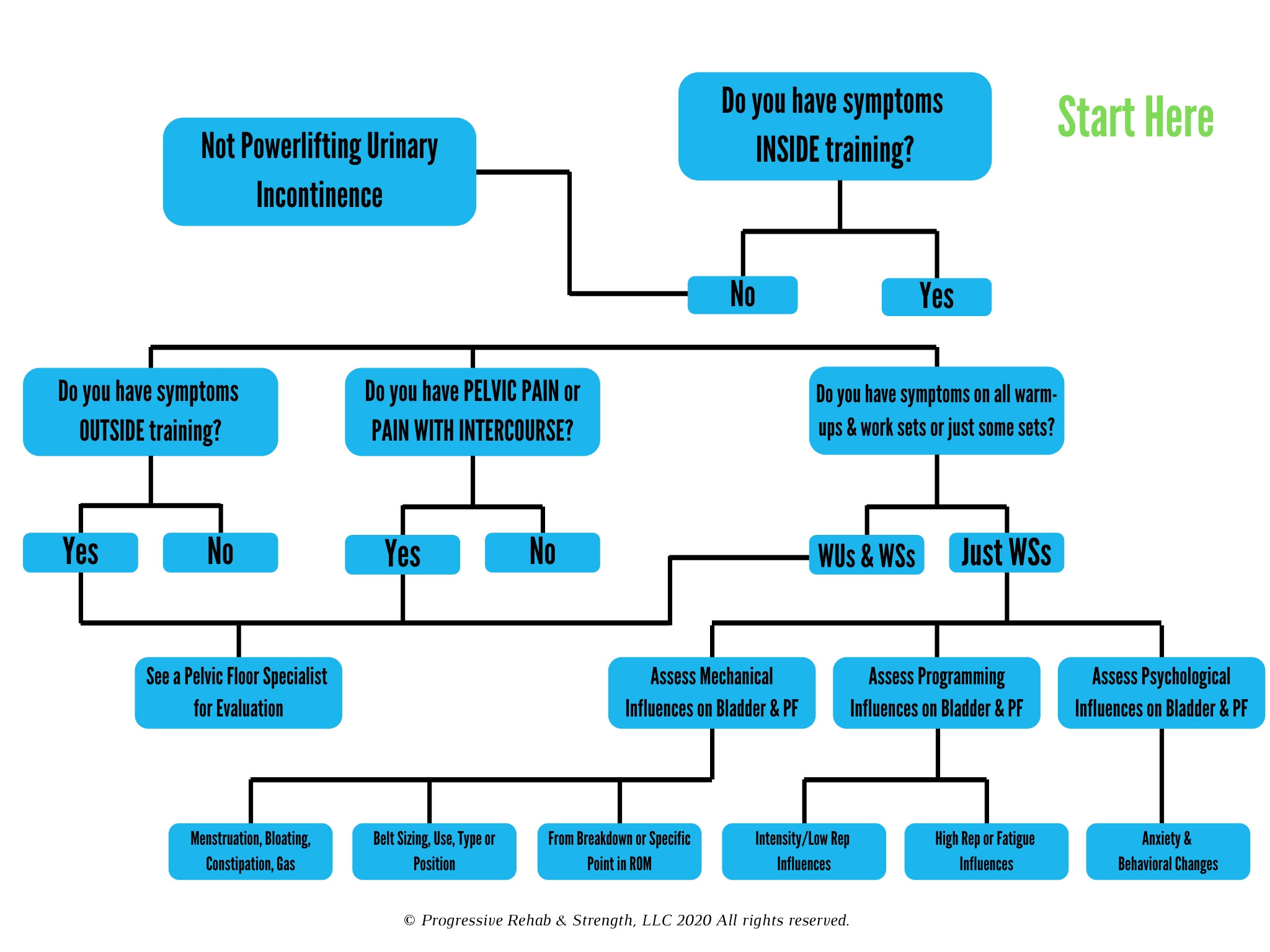
Answering those 10 questions volition provide a good starting point to begin addressing the issue and for a female who has low to no chance factors for or symptoms of typical urinary incontinence, the outcome can nearly undoubtedly exist resolved.
There are three realms of powerlifting urinary incontinence that tin easily be identified and managed. These include mechanical contributions that place pressure on your bladder while you lift, programming contributions that can easily be monitored and modified, as well as psychological areas that can be retrained to reduce your symptoms.
So, if you lot go through the flow chart to a higher place and determine yous're likely experiencing powerlifting related incontinence, check out Part two here. However, if you lot're concerned virtually the issue and experience you demand a more personailzed approach to identifying and addressing your symptoms, set a free consultation phone call with our Women's Health Clinical Coaches today! Request a free consultation HERE.
If you're interested in learning how to optimize barbell technique, maximize forcefulness and muscular evolution, and reduce injury take a chance (and peeing) for you, your clients or patients, and then bring together the waitlist to get insider information on all the PRS online courses when they're ready for enrollment!
Citations
-
Ball R, Weidman D. Analysis of USA Powerlifting Federation Data From Jan 1, 2012-June 11, 2016. J Strength Cond Res. 2018;32(seven):1843–1851. doi:10.1519/JSC.0000000000002103
-
Alter-Petrizzo R, Petrizzo J, Wygand J, Otto R. Stress Urinary Incontinence in Female person Powerlifting: A Survey. Medicine & Scientific discipline in Sports & Practise. 2018; doi:10.1249/01.mss.0000538444.72232.53
-
Araujo MP, Sartori MGF, Girão MJBC. Able-bodied Incontinence: Proposal of a New Term for a New Woman. Incontinência de atletas: proposta de novo termo para uma nova mulher. Rev Bras Ginecol Obstet. 2017;39(9):441–442. doi:10.1055/s-0037-1605370
-
Luber KM. The definition, prevalence, and hazard factors for stress urinary incontinence. Rev Urol. 2004;6 Suppl three(Suppl 3):S3–S9.
pendergrasswrife1945.blogspot.com
Source: https://www.progressiverehabandstrength.com/articles/urinary-incontinence-powerlifting-part-1
Post a Comment for "Not in My Belts! I Wet My Pants Again"